


Content Menu
● Key Components and Features of Water Trucks
● Main Functions and Uses of Water Trucks
>> Dust Control and Suppression
>> Fire Control and Fire Prevention
>> Agricultural Irrigation and Livestock Care
>> Residential and Commercial Water Delivery
>> Environmental and Dust Suppression in Mining
● Frequently Asked Questions (FAQ)
>> 1. What industries commonly use water trucks?
>> 2. How much water can a typical water truck carry?
>> 3. Do water trucks have safety features to prevent accidents?
>> 4. Can water trucks distribute drinking water?
>> 5. How do water trucks help control dust effectively?
Water trucks are essential vehicles designed to store, transport, and distribute large volumes of water efficiently across various industries and applications. Serving critical roles in construction, mining, agriculture, firefighting, and residential water delivery, water trucks help ensure safety, environmental protection, and operational efficiency. Their versatility stems from advanced designs, specialized equipment, and the ability to operate in demanding environments.

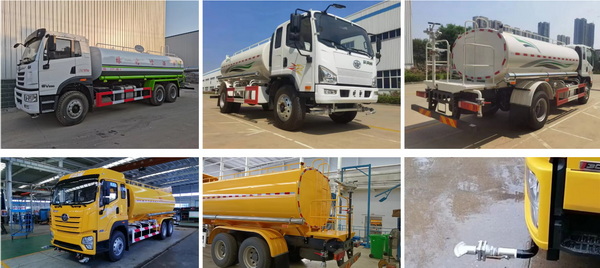
A water truck is a heavy-duty vehicle equipped with a large-capacity water tank, pumps, and spray mechanisms that enable it to carry and disperse water over large areas or at specific points of need. The vehicle chassis is often reinforced to carry the heavy loads of water safely while maintaining maneuverability even over rough terrain. Water trucks vary in size, with tank capacities ranging from as low as 1,000 gallons to over 20,000 gallons depending on their purpose and industry requirements. Common manufacturers for the truck chassis include Kenworth, Ford, Mack, and International, which are known for producing durable and reliable trucks to meet site challenges.[1][2]
Water trucks come with a few core components that work together to ensure effective water transport and application:
- Water Tank: Usually constructed from steel or aluminum, these tanks hold the water securely during transit. The size of the tank significantly influences the truck's function, with larger tanks serving long-duration operations.
- Pump System: The pump pushes water from the tank through hoses and spray nozzles. Pumps must be powerful to maintain the required pressure for spraying and other water delivery methods.
- Spray Nozzles and Attachments: Water trucks include various outlets such as spray bars, water cannons, hose reels, and dribble bars that facilitate different water application techniques, ranging from broad spraying for dust control to targeted watering for irrigation or firefighting.
- Control System: Controls are primarily located inside the truck cabin, allowing the operator to manage water flow and spray patterns safely without needing to exit the vehicle.
- Chassis and Suspension: Designing for heavy water loads, water trucks have specialized frames and suspension systems to keep balance and stability, even on uneven or off-road surfaces. Low center of gravity designs mitigate the risk of truck rollover during water delivery.[2][3][1]
Water trucks perform a wide range of functions essential for different sectors, maximizing their adaptability and operational value.
One of the most common uses for water trucks is dust control on construction sites, mining operations, dirt roads, and unpaved areas. Dust from earthmoving and vehicle traffic poses health hazards by causing respiratory problems and can also reduce visibility, increasing accident risks. By spraying water uniformly over dusty surfaces, water trucks reduce airborne particles significantly, improving worker safety and environmental conditions. Dust control also helps sites remain compliant with government and environmental regulations, making water trucks a necessity for maintaining safe and sustainable operations.[4][1][2]
Water trucks are critical assets for firefighting, especially in rural areas or large industrial sites lacking permanent fire hydrants. They can rapidly deliver large volumes of water to a fire scene or wet down fire-prone areas to reduce the risk of wildfire outbreaks. These trucks support firefighting crews by providing a mobile water source while helping protect property and natural resources from fire damage. Some models are specifically designed to handle rough terrain and harsh conditions, vital during wildfire suppression activities.[1][2][4]
Proper soil compaction is necessary for constructing foundations of roads, bridges, and buildings. Water trucks assist by supplying moisture to the soil, which helps bind particles together giving the soil proper density and strength. The trucks' water distribution systems ensure even application, improving compaction quality and reducing structural risks such as subsidence or shifting. This function is particularly important for highway construction and large-scale earthworks.[4][1]
In agriculture, water trucks provide essential irrigation support during dry seasons or in regions without permanent irrigation infrastructure. They supply water to crops, orchards, and pastures by transporting recycled or fresh water directly to where it is needed. Additionally, water trucks supply water for livestock in remote grazing areas, improving animal health and productivity. Farmers and agribusinesses rely on these trucks to maintain stable water supply during critical growth periods and droughts.[1][4]

Water trucks are used for various residential and commercial purposes including filling swimming pools, landscaping irrigation, and supplying drinking water during emergencies or municipal supply shortages. Their ability to deliver water quickly and efficiently makes them ideal for construction sites requiring potable water and for special events in remote locations. This usage highlights the water truck's role in water logistics for urban and rural settings alike.[4][1]
Mining sites frequently generate dust due to excavation and material handling. Dust from these operations poses environmental hazards and interrupts visibility. Water trucks regularly spray dust suppression mist, protecting workers' health and minimizing environmental impact. Given the large scale of mining operations, water trucks here are typically robust and have high-capacity tanks to maximize operational efficiency.[1][4]
Water trucks present distinct advantages enabling industries to maintain safe and effective operations:
- Large Volume Delivery: Ability to transport thousands of gallons of water in one trip reduces the need for multiple deliveries.
- Mobility: Can access remote or difficult terrain to deliver water precisely where needed.
- Multi-Purpose Use: Due to adaptability of spray systems and tank sizes, water trucks work in many sectors.
- Environmental Compliance: Help companies meet regulations related to dust, air quality, and fire safety.
- Time and Cost Savings: Speedy water application reduces labor and operational downtime.
- Customization Options: Various configurations including tank size, spray coverage, and pump power allow tailoring to project needs.[2][4][1]
Water trucks are indispensable across numerous industries due to their ability to efficiently transport and apply water for critical functions such as dust suppression, firefighting, soil compaction, agricultural needs, and water delivery. Their high-performance designs, coupled with customizable features, make them essential tools in construction, mining, agriculture, emergency response, and residential services. Effective use of water trucks optimizes safety, environmental responsibility, and operational productivity, making them a smart investment for any business requiring water management on the move.
Water trucks are commonly used in construction, mining, agriculture, firefighting, and residential water delivery. These industries rely on water trucks for dust control, irrigation, fire prevention, soil compaction, and emergency water supply.[4][1]
Typical water trucks carry between 1,000 and 20,000 gallons of water, though tank sizes vary according to the truck's design and intended use.[5][2]
Yes, water trucks are designed with heavy-duty chassis and suspension systems to maintain stability, especially on uneven terrain. Some models feature low center of gravity to minimize rollover risks. Operators control water dispensing from inside the cab, enhancing safety.[3][5]
Yes, many water trucks are equipped to safely transport and distribute potable (drinking) water for emergency use, residential supply, or events.[1][4]
Water trucks reduce dust by spraying a controlled amount of water over dusty surfaces, which prevents dust particles from becoming airborne. This improves air quality and reduces health hazards for workers and surrounding communities.[2][4]
[1](https://www.eamtrucks.com/post/what-are-water-trucks-used-for)
[2](https://www.equipmentshare.com/articles/water-trucks-101-what-is-a-water-truck-used-for)
[3](https://kleinproducts.com/klein-unveils-model-k400ss-td-a-one-of-a-kind-innovative-dual-purpose-water-truck/)
[4](https://currysupply.com/5-common-applications-water-trucks/)
[5](https://www.drivingtests.co.nz/resources/whats-a-water-truck-and-are-they-stable/)


